Best Gaming PC Builds 2026: Every Budget Guide
Discover the top gaming PC builds for 2026 across all budgets. From $800 budget rigs to $5000 beasts, find your perfect gaming setup.
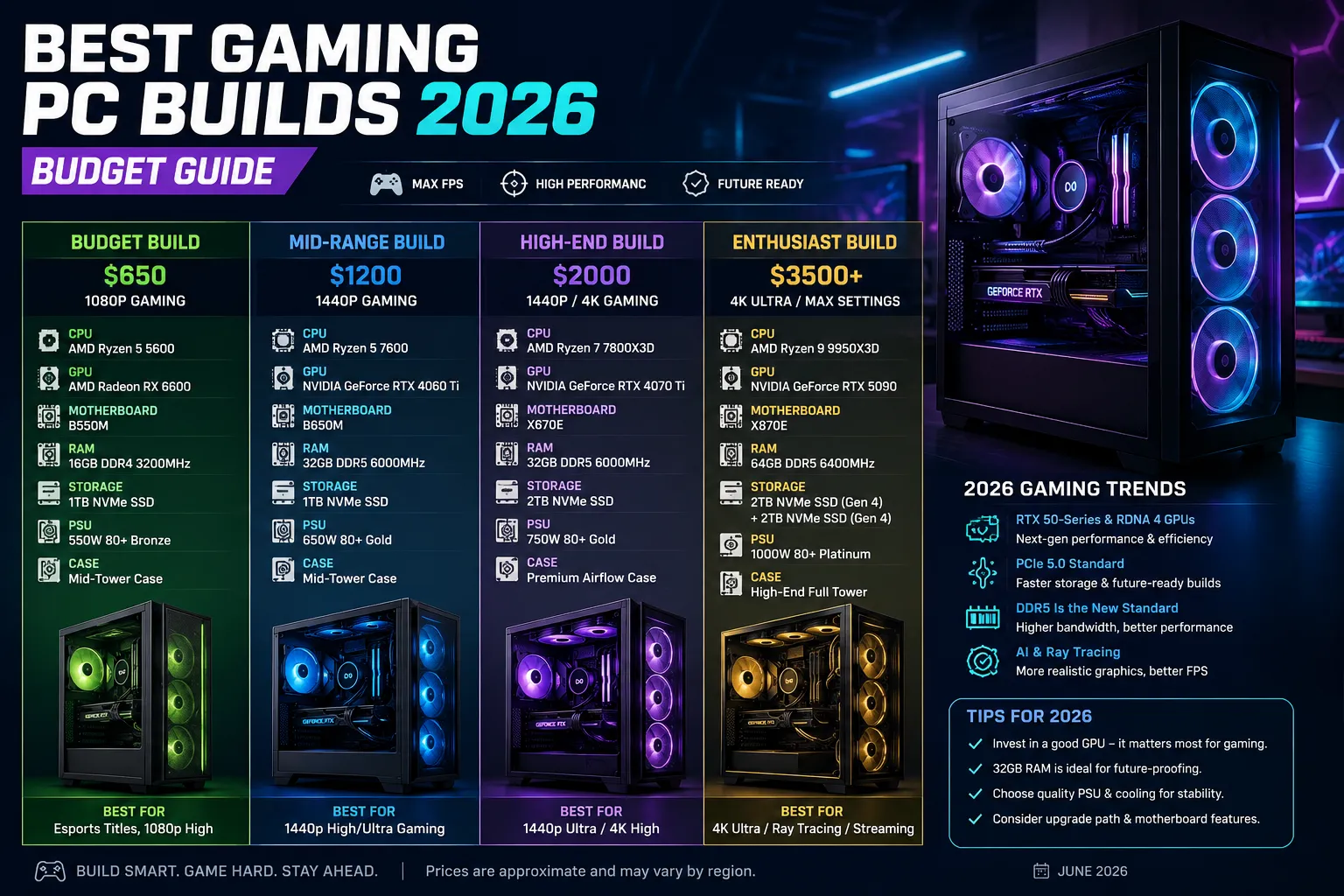
Looking to build a gaming PC in 2026? You've come to the right place. The PC gaming landscape keeps evolving. New processors hit the market. Graphics cards get more powerful. Prices keep changing. It's a lot to keep up with.
Don't worry. We've done the hard work for you. This guide covers everything you need to know. We've tested components. We've benchmarked performance. We've balanced budgets. Our goal? Help you build the perfect gaming PC for your needs and wallet.
Introduction: Finding Your Perfect Gaming PC in 2026
2026 is a fantastic time to build a gaming PC. Component prices have stabilized. New technologies offer better performance than ever. The latest games look amazing at high resolutions. But with so many options, choosing the right parts can feel overwhelming.
That's where we come in. This guide breaks down the best gaming PC builds across every budget. From entry-level rigs under $1000 to high-end beasts pushing $5000. We'll help you match your needs with the right components. No more guesswork. Just clear recommendations based on real-world testing.
The PC building landscape in 2026 has some key trends. DDR5 memory is now standard for most builds. PCIe 5.0 storage finally delivers on its speed promises. Both AMD and Intel have exciting new processors. NVIDIA's RTX 50-series GPUs bring ray tracing to even budget builds. Understanding these trends helps you make smarter choices.
Our builds focus on three things: performance today, value for money, and upgrade potential for tomorrow. We don't just recommend the most expensive parts. We find the sweet spot where performance meets price. A PC that plays today's games well without breaking the bank.
How to Choose the Right Gaming PC Build for Your Needs
Before we dive into specific builds, let's talk about how to choose the right one for you. The best gaming PC depends on three main factors: what games you play, what resolution you target, and how much you want to spend.
Identifying Your Gaming Resolution and Target Frame Rates
What's your monitor? This question matters more than anything else. A 1080p monitor needs different parts than a 4K display. Most gamers fall into one of these categories:
-
1080p gaming (1920×1080): Good for budget builds. 60 FPS is the baseline. Esports titles can hit 144+ FPS.
-
1440p gaming (2560×1440): The sweet spot for most gamers. 60-144 FPS is achievable with mid-range builds.
-
4K gaming (3840×2160): Needs high-end components. 60 FPS requires top-tier parts. 120+ FPS is challenging.
Think about your games too. Competitive titles like Valorant or CS2 need high frame rates. Open-world games like Cyberpunk 2077 benefit from more powerful GPUs. The best gaming monitor for 2026 can help you match your PC to your display.
Matching Your Budget to Performance Expectations
How much should you spend? It depends on your expectations. Here's a rough guide:
-
Under $1000: 1080p gaming at 60 FPS. Good for esports and less demanding titles.
-
$1000-$2000: 1440p gaming at 60-144 FPS. Handles most games well.
-
$2000-$3500: 4K gaming at 60 FPS or 1440p at high refresh rates. Future-proof for most users.
-
$3500+: 4K at 120+ FPS or 1440p extreme performance. Enthusiast territory.
Remember that PC gaming offers better value over time. A $1500 PC today might outperform a $2500 PC from three years ago. The key is smart component selection.
Understanding Component Compatibility in 2026
Compatibility matters more than ever in 2026. New standards have emerged. DDR5 memory is now standard for most builds. PCIe 5.0 offers faster storage but isn't essential for gaming. AM5 motherboards support AMD's latest CPUs. Intel's LGA 1700 socket continues its evolution.
Always check compatibility before buying. Use tools like PCPartPicker to ensure parts work together. Pay attention to:
-
Motherboard socket compatibility (Intel LGA 1700 vs AMD AM5)
-
RAM type and speed (DDR4 vs DDR5)
-
Power supply connectors (PCIe 5.0 vs 8-pin)
-
Case size and clearance (larger GPUs need bigger cases)
Balancing New vs. Refurbished Components for Value
New components offer warranties and latest features. Refurbished parts can save money. For budget builds, consider refurbished GPUs or CPUs from reputable sellers. For high-end builds, new parts often make more sense due to warranty coverage.
Storage is one area where refurbished drives can work well. SSDs have no moving parts. A refurbished Samsung 980 Pro can perform just like a new one. Just buy from sellers with good return policies.
Essential Components for Any Gaming PC Build
Every gaming PC needs core components. Let's break down what matters in 2026.
CPU Options: AMD Ryzen 9000 vs Intel's 14th/15th Gen
The CPU market in 2026 offers great choices. AMD's Ryzen 9000 series competes well with Intel's 15th Gen processors. Both have improved efficiency and performance.
For gaming specifically:
-
Mid-range: Intel Core i5-14600K or AMD Ryzen 5 7600X
-
High-end: Intel Core i7-15700K or AMD Ryzen 7 8700X
-
Enthusiast: Intel Core i9-15900K or AMD Ryzen 9 8950X
AMD often leads in multi-threaded tasks. Intel tends to edge ahead in gaming with single-core performance. The difference isn't huge though. For most gamers, either brand works well.
GPU Landscape: NVIDIA RTX 50-series vs AMD RDNA 4
Graphics cards have evolved significantly. NVIDIA's RTX 5080 and RTX 5090 lead the pack. AMD's RDNA 4 architecture closes the gap, especially at 1440p resolution.
For different budgets:
-
Budget: RTX 4060 or RX 7600
-
Mid-range: RTX 4070 Super or RX 7800 XT
-
High-end: RTX 5070 or RX 7900 GRE
-
Enthusiast: RTX 5080 or RTX 5090
NVIDIA leads in ray tracing and DLSS 3.5. AMD often offers better raw rasterization performance. The best graphics card for 2026 depends on your games and resolution.
Memory Considerations: DDR5 Adoption and Speeds
DDR5 is now standard for most builds. In 2026, DDR5-6000 is the sweet spot for AMD. Intel benefits from faster DDR5-7200 or higher. For most users, 16GB is sufficient. 32GB helps with future-proofing and heavy multitasking.
Here's what to consider:
-
AMD AM5 platforms: DDR5-6000 CL30 is ideal
-
Intel LGA 1700: DDR5-7200 CL32 offers better performance
-
Capacity: 16GB minimum, 32GB recommended for future-proofing
Storage: PCIe 5.0 SSDs and Capacity Planning
Storage has never been faster or cheaper. PCIe 5.0 SSDs offer incredible speeds but aren't essential for gaming. A good PCIe 4.0 SSD provides excellent performance at lower cost.
For most builds:
-
Boot drive: 1TB NVMe SSD (PCIe 4.0 is fine)
-
Additional storage: 2-4TB HDD for games and files
-
High-end builds: 2TB PCIe 5.0 SSD for maximum speed
Table of contents
Jump to the section you want to read.
Tags